They Joined for the Snacks. They Stayed for the Life Change.
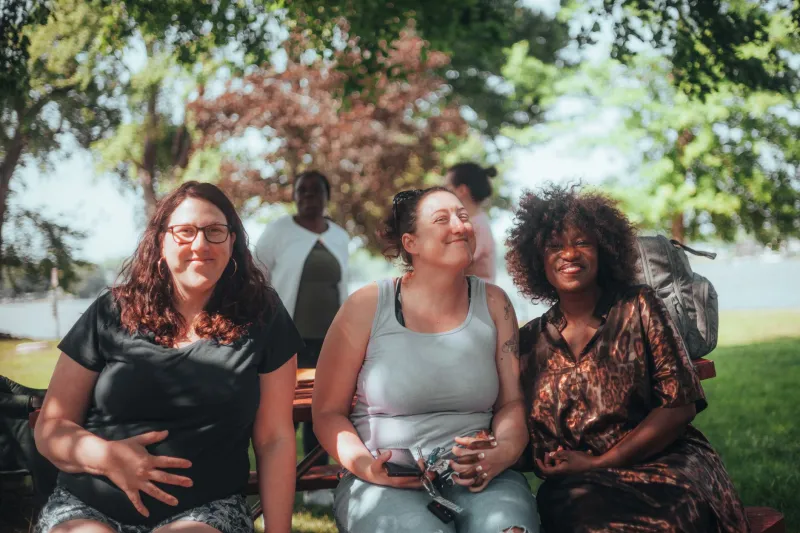
Renée Castillo joined a book club in Austin, Texas, mostly because her neighbor wouldn't stop talking about it. She figured it'd be a decent excuse to drink wine on Tuesday nights and maybe finally finish a novel that wasn't a thriller. What she didn't expect was that eighteen months later, she'd be handing in her resignation at a marketing firm where she'd spent eleven years climbing a ladder she'd quietly started to hate.
"It sounds dramatic," she says, laughing a little. "But that group gave me permission to want something different. We read this one book about craft and making things with your hands, and I just started crying in someone's living room. That was kind of the beginning of the end — of my old life, I mean."
Renée now runs a small pottery studio out of a converted garage in East Austin. She's not rolling in cash. She's never been happier.
Stories like hers aren't flukes. Across the country, people are walking into clubs with modest expectations — a hobby to pick up, some faces to put names to — and walking out months or years later having rerouted their entire lives. The catalyst isn't always obvious. Sometimes it's a single conversation. Sometimes it's just the slow accumulation of being truly seen by a group of people who have no professional stake in your success.
The Pressure-Free Zone That Changes Everything
Psychologists have a term for it: identity exploration in low-stakes environments. When you're not being evaluated by a boss or performing for family members who have a fixed idea of who you are, something opens up. Club spaces — especially ones built around shared interests rather than shared backgrounds — tend to strip away a lot of the social armor people carry everywhere else.
Marcus Webb, a 34-year-old from Columbus, Ohio, found this out through a running club he joined mostly to get off his couch after a rough breakup. Within a year, he'd reconciled with his estranged father.
"There was this older guy in the group, Earl. Retired teacher, ran like a machine. He and I started doing the long Saturday runs together, and we just... talked. About everything. He'd had a falling out with his own son years back, and hearing his side of that story kind of cracked something open in me." Marcus called his dad the following Sunday. They've been talking every week since.
Earl didn't set out to be anyone's therapist. He was just showing up, week after week, the way good club members do.
When the Group Becomes a Mirror
One of the stranger things about club life is how other people's journeys can illuminate your own. You watch someone in your ceramics class finally submit their work to a gallery. You see a fellow trivia night regular pivot from a dead-end job to community college at 42. And something in you shifts — not because they lectured you, but because their choices made yours feel possible.
That's what happened for Dominique Harris, who joined a natural hair care community in Atlanta after years of feeling out of place in predominantly white professional spaces. She'd expected tips on deep conditioning. What she got was a crash course in self-advocacy.
"These women were unapologetically themselves in a way I hadn't seen modeled in my daily life," she says. "I started showing up differently at work. I stopped shrinking. I got a promotion six months after joining that group — and I genuinely think it's connected."
She's now a co-organizer of the group, helping plan quarterly meetups and mentorship pairings for newer members.
The Thing No Self-Help Book Can Replicate
Here's the part that's hard to package into a podcast or a productivity app: the transformation that happens inside a real community is fundamentally relational. It's not about content or curriculum. It's about the specific chemistry between specific people who keep showing up to the same place, over and over, until something real grows between them.
Jordan Patel, who joined a tabletop gaming club in Denver on a whim, puts it plainly: "I came in as someone who thought of himself as a loner. I'm still introverted. But I learned I actually like people when there's a reason to be together. That sounds small. It wasn't."
Jordan now runs game nights at a local library, introducing the hobby — and the community — to kids who remind him of his younger self.
None of these people are outliers. They're just what happens when you give people a consistent space, a shared purpose, and enough time. The club doesn't change you. It just makes the space for you to change yourself — with a little help from your people.
If you've been on the fence about joining something, consider this your nudge. The worst case? You get some snacks and a decent conversation. The best case? Well, ask Renée.