Why Americans Are Finding Their People in the Most Specific Places Imaginable
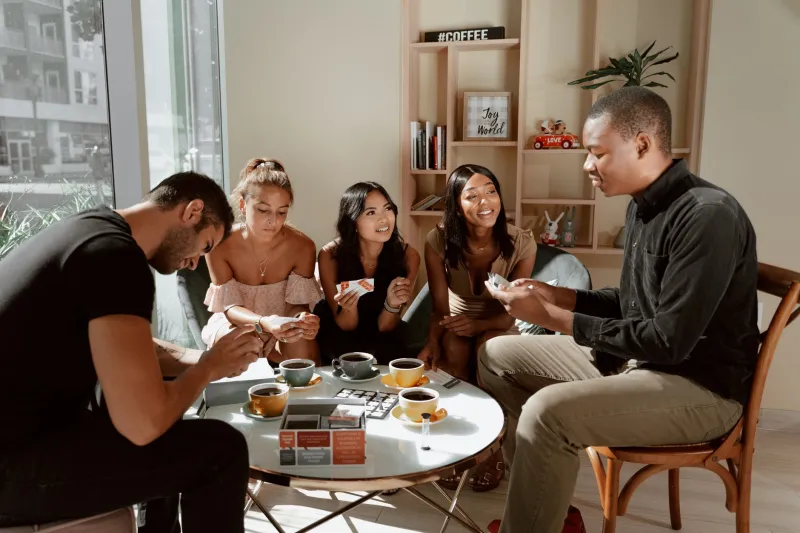
Somewhere in Brooklyn, a group of people meets every other Thursday to listen — really listen — to obscure 1970s Ethiopian jazz. Not to talk over it. Not to use it as background noise while they network. To sit with it, discuss it, and geek out together about production choices most people have never thought to notice. The group has a waitlist.
In Phoenix, a competitive Eurogame league has grown from six friends at a kitchen table to over two hundred members with a point system, seasonal championships, and enough drama to fuel its own podcast. In Portland, a club dedicated entirely to the study and appreciation of vintage seed catalogs has been meeting monthly for three years.
This is the new American social club. And it is nothing like what your grandparents joined.
The Decline of the Big Tent
For most of the twentieth century, American social life was organized around big, broad institutions — churches, civic organizations like the Elks and the Rotary Club, union halls, neighborhood associations. These weren't places you went because you shared a specific passion. They were places you went because you shared a geography, a faith, or a profession. The common ground was wide but often shallow.
The data on what's happened since is pretty stark. Church attendance has dropped dramatically over the past two decades. Civic organization membership has been declining since at least the 1970s, a trend famously documented by Robert Putnam in Bowling Alone. Even informal socializing — having neighbors over for dinner, hanging out with friends on a weeknight — has become less frequent for many Americans.
But here's what's interesting: people didn't stop wanting community. They started looking for it somewhere else. And increasingly, they're finding it in places that are almost aggressively specific.
When Niche Is Actually the Point
There's a counterintuitive thing that happens when you build a community around something really specific: it actually brings people closer together, faster. When everyone in the room cares deeply about the same narrow thing — whether that's competitive Scrabble, natural wine, sourdough fermentation, or a particular strain of horror fiction — you skip a lot of the small talk that makes broad social settings feel exhausting.
You already have something real to talk about. You already have a shared vocabulary. You already know, on some level, that the people around you see the world in at least one important way the way you do. That's not a small thing. In a culture where genuine connection often feels hard to come by, it's actually huge.
Researchers who study social belonging have a term for this: identity-based connection. When a community is built around something you actively chose and care about — rather than something you were born into or ended up in by default — the sense of ownership and investment tends to be much stronger. You didn't just end up here. You sought this out. That makes it yours in a different way.
The Internet Lit the Match, But the Fire Is Real
It would be easy to credit (or blame) the internet for all of this, and the online world certainly played a role. Reddit communities, Discord servers, and Facebook groups made it possible for people with hyper-specific interests to find each other across geographic boundaries. Someone in rural Kansas who's obsessed with Scandinavian folk textiles can now connect with a dozen other people who share that exact passion.
But what's striking is how often these online communities eventually push toward the physical. The Ethiopian jazz listening club started as a Spotify playlist shared between two people on Twitter. The seed catalog group grew out of a subreddit. The board gaming league coalesced from a Discord server that kept saying "we should really do this in person."
The internet is the matchmaker. The real relationship — the one that actually fills the social void — happens when people show up in the same room.
What This Tells Us About American Identity Right Now
There's something genuinely revealing about the kinds of communities that are thriving in this moment. People aren't just looking for fun activities. They're looking for places where their specific, particular self — not a generalized version of it — is the thing that gets them in the door.
For a long time, the dominant narrative about American identity was about assimilation into something bigger: the melting pot, the civic commons, the broad-based middle. What's emerging now looks more like a mosaic — not fragmented, but intricate. People are finding belonging not despite their specificity, but because of it.
This has real implications for how we think about social health in the US. The old institutions that provided community were often one-size-fits-all in ways that left a lot of people on the margins — people whose interests, identities, or values didn't map cleanly onto what the local church or Rotary Club offered. The new model is more permeable. You can find your people without having to flatten yourself to fit.
The Mainstream Is Catching On
What started as a fringe phenomenon is showing up in increasingly mainstream places. Major cities now host dedicated board game cafes, vinyl listening bars, and community fermentation labs. Brands have noticed — there are corporate-sponsored "interest communities" popping up everywhere, which is either validation of the trend or a sign that it's about to be co-opted, depending on your level of cynicism.
Libraries and community centers are quietly becoming some of the most interesting places in American social life, hosting everything from mushroom foraging clubs to fan fiction writing groups. The infrastructure for niche community is growing.
And platforms like Checha Club exist precisely because there's real demand for spaces where people can find communities built around genuine shared passion — not just shared demographics or shared geography.
Finding Your Specific Corner of the World
If you've ever felt like the traditional social options available to you were a little... generic, the rise of passion-based clubs is good news. The specificity that might have made you feel like an outsider in a broad social setting is exactly the thing that will make you feel at home in the right community.
The seed catalog people found each other. The Ethiopian jazz listeners found each other. The competitive board gamers built something that actually matters to them.
Your corner of the world is out there too. Sometimes you have to build it yourself. But more and more often, someone else already started — and they've been waiting for you to show up.