When the Group Gets Too Big: How Smaller Circles Inside Clubs Become the Ones That Actually Matter
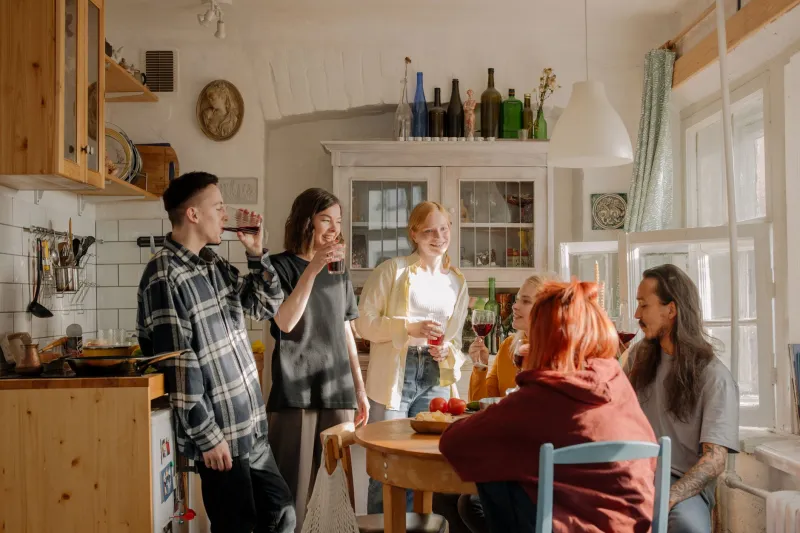
There's a moment most club members recognize, even if they've never put words to it. You've been showing up for a few months. You like the group. You enjoy the events. But somewhere along the way, you started looking forward less to the meeting itself and more to the four or five people you always end up standing next to afterward. The ones who get your jokes. The ones who text you memes about the thing you all talked about last Tuesday.
Congratulations. You've found your subgroup. And honestly? That might be the best thing the club ever gave you.
Why Big Groups Can Only Do So Much
There's a well-worn concept in social psychology called Dunbar's Number — the idea, developed by British anthropologist Robin Dunbar, that humans can only maintain about 150 meaningful social relationships at any given time. Zoom in further, and the numbers get even tighter. The layer of people we'd call close friends? Somewhere between five and fifteen.
Clubs, by nature, tend to push past that ceiling. A thriving community organization might have 80 members. A popular hobby collective could have 300. A neighborhood social club might span entire zip codes. That scale is great for resources, events, and visibility. But it's genuinely hard to feel known inside a crowd that large.
Enter the subgroup.
These aren't official committees or formal breakout teams. They're organic. They form because two people discover they both grew up in the same part of the country, or three members realize they all have kids the same age, or a handful of folks keep staying late to help stack chairs and eventually start going for tacos after. The main club is the container. The subgroup is what fills it up.
"It's Like Having a Club Within the Club"
Marcus, a 34-year-old in Atlanta who's been part of a local cycling collective for three years, describes his inner circle as "the people I'd actually call if something went wrong." The larger club has over 200 members and hosts rides every weekend. But Marcus's real community? Six guys who started a separate group chat after a particularly brutal hill climb left them all cursing and laughing at the same time.
"We still show up for the big rides," he says. "But our little crew plans our own routes, does dinner after, talks about stuff that has nothing to do with bikes. The club introduced us. But we built something different."
That pattern — club as introduction, subgroup as relationship — shows up everywhere. In book clubs where a few members start a separate thread to actually discuss the books (instead of just socializing). In running groups where a slower pace pod quietly becomes the most tightly bonded unit. In professional networking clubs where two or three people with overlapping industries end up becoming genuine collaborators.
The main organization provides the infrastructure. The subgroup provides the intimacy.
The Psychology Behind Why Smaller Feels Safer
It's not just warm feelings — there's real science behind why these micro-communities hit different. Smaller groups reduce what researchers call social evaluation anxiety, that low-grade stress of performing for a crowd. When you're one of fifty people at a club meeting, there's a subtle pressure to present a version of yourself that's acceptable to the whole room. When you're one of six people who already know your deal, that pressure mostly evaporates.
Psychologists also point to something called parasocial compression — the idea that the more people share repeated, low-stakes experiences together, the faster they build trust. A big club event is high-production and often high-stakes. A subgroup's spontaneous Saturday afternoon hang is neither. And that casualness is exactly what accelerates closeness.
There's also the factor of shared specificity. The thing that bonds a subgroup is almost always more specific than what bonds the larger club. The main club might be united by "we love hiking." The subgroup is united by "we love hiking AND we all think the same trail is overrated AND we've all had the exact same argument about trekking poles." That specificity creates a kind of shorthand that's genuinely hard to manufacture at scale.
When the Subgroup Becomes the Point
For some members, the inner circle eventually eclipses the original organization entirely — not in a dramatic way, but in a quiet, honest one. They keep renewing their membership, keep showing up to big events, but if you asked them what the club really means to them, they'd describe the smaller circle without hesitation.
Jamila, a 29-year-old in Chicago who joined a creative writing club two years ago, puts it plainly: "The club gave me a place to start. But my writing group — it's just four of us now — that's where I actually grew. We read each other's drafts, we're honest, we know each other's weird writing habits. The bigger club is fun. But those three people changed how I see myself as a writer."
That's not a failure of the larger club. If anything, it's a sign of success. A club that generates those kinds of splinter connections is doing something right.
What Clubs Can Learn From Their Own Subgroups
Organizers and community leaders would do well to pay attention to where these micro-communities naturally form — because they're often pointing toward something the main structure is missing. If a subgroup keeps forming around members who are newer and feel lost, that's a signal about onboarding. If the most passionate subset of members is clustering around a specific niche interest, that might be worth programming around.
The healthiest clubs don't try to absorb or formalize every subgroup. They leave room for them. They celebrate the fact that a few members started their own thing on the side. Because that side thing is proof that the original community created the conditions for real connection — and then got out of the way.
Find Your Five
If you're a club member who's been showing up but still feels like you're floating on the surface, it might not be the club that's the problem. It might just be that you haven't found your people-within-the-people yet.
Pay attention to who you gravitate toward after the formal stuff ends. Notice who laughs at the same things you do, who lingers when everyone else is heading out, who sends a message the next day about something you mentioned in passing. That's not random. That's the beginning of something.
The big club is where you show up. The small circle is where you belong. And more often than not, you can't get to the second one without the first.